
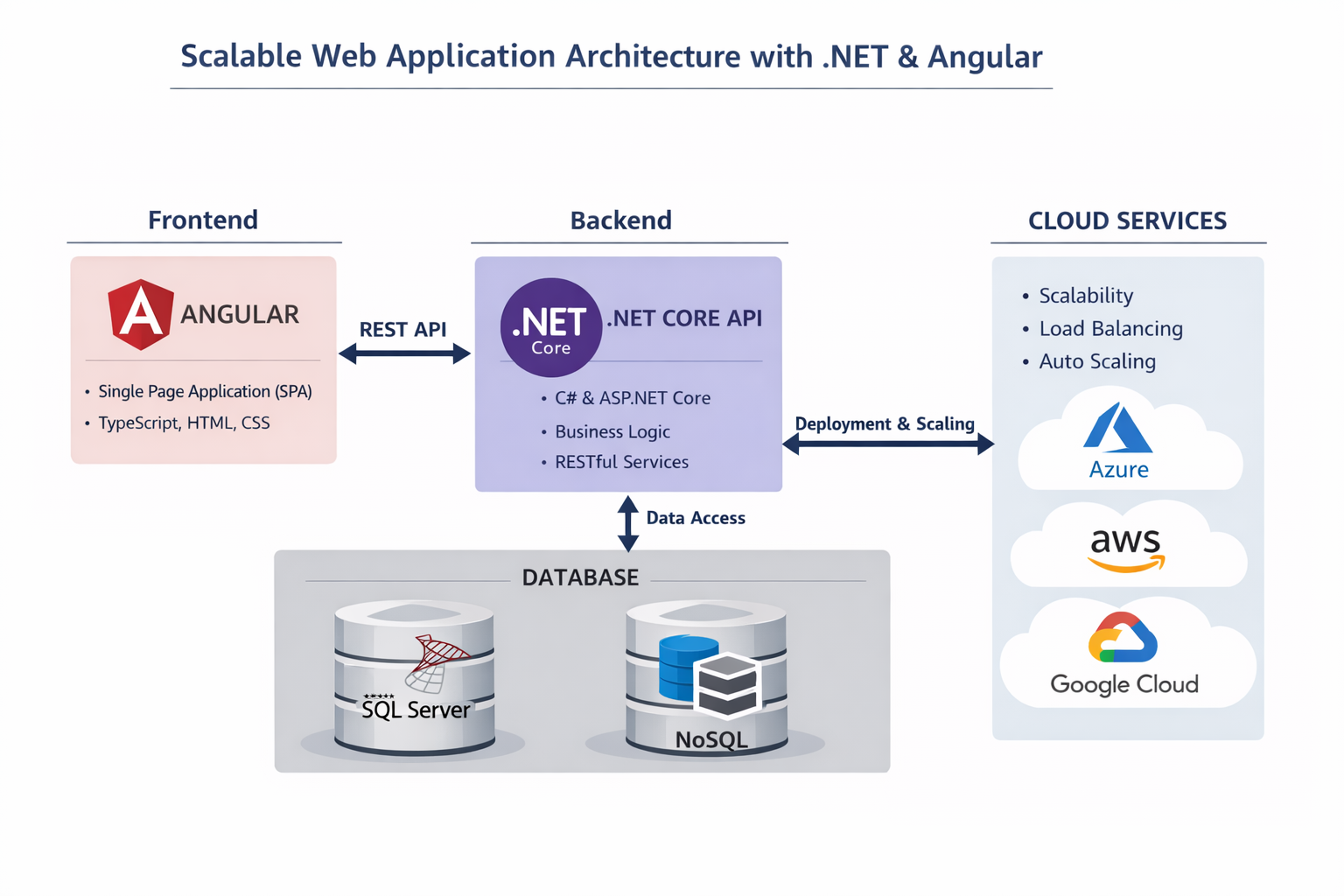
Building a web app is easy. Making it handle thousands of users without breaking? That’s where things get real.
If you’re serious about growth, you need to understand how to build scalable web applications with .NET & Angular.
Honestly, many developers skip scalability in the beginning. Later, when traffic increases, everything starts slowing down.
Let’s fix that early so your app grows smoothly without headaches.
To build scalable web applications with .NET & Angular, use a layered architecture, implement microservices, optimize APIs, use lazy loading in Angular, and deploy on cloud platforms like Azure. Focus on performance, caching, and database optimization to handle high traffic efficiently.
Table of Contents
- What Makes a Web Application Scalable?
- Best Architecture for .NET & Angular Apps
- Building a Scalable .NET Backend
- Optimizing Angular for Scalability
- Performance Optimization Tips
- Cloud Deployment & Scaling
- Monolith vs Microservices
- FAQ
1. What Makes a Web Application Scalable?
Scalability means your app can handle more users without slowing down. Simple, right? But achieving it needs planning.
Key Factors of Scalability
- Efficient code and architecture
- Load balancing
- Database optimization
- Caching strategies
- Cloud infrastructure
Look, if your app crashes when 100 users log in, it’s not scalable. If it handles 10,000 users smoothly, you’re on the right track.
You can also check MDN Web Performance Guide for deeper performance insights.
Want to learn backend optimization? Check this .NET performance guide.
2. Best Architecture for .NET & Angular Apps
Here’s the thing — architecture matters more than code sometimes. A bad structure will slow you down later.
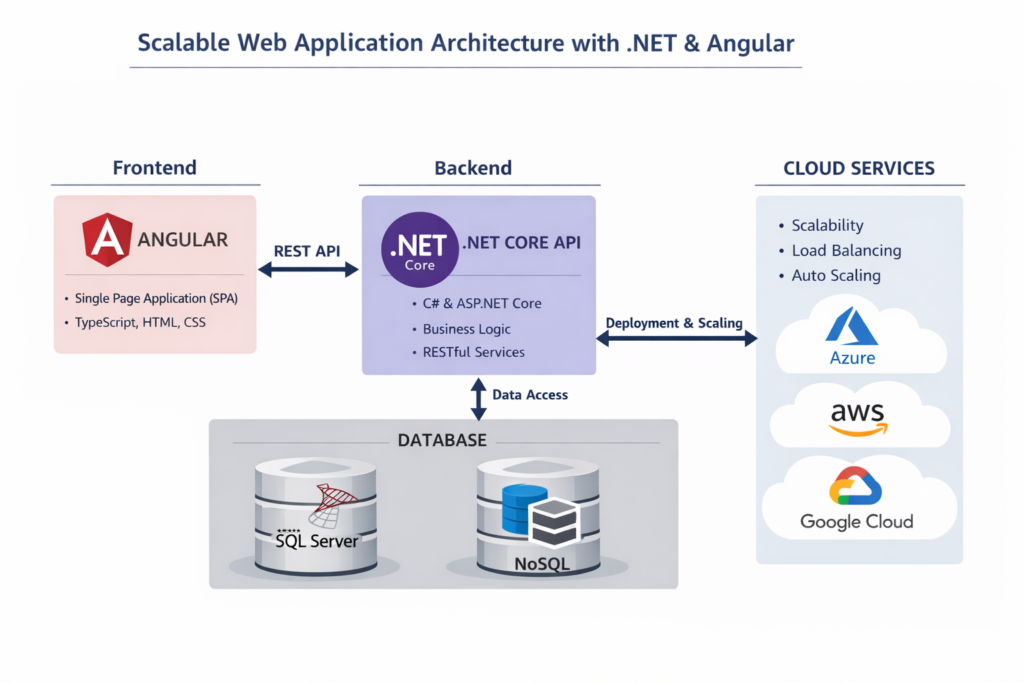
Recommended Architecture
- Frontend: Angular (SPA)
- Backend: .NET Web API
- Database: SQL Server / NoSQL
- Architecture: Clean Architecture or Microservices
Clean Architecture keeps your code organized. Microservices help you scale different parts independently.
3. Building a Scalable .NET Backend
Your backend does the heavy lifting. If it’s not optimized, your whole app suffers.
Best Practices for .NET Backend
- Use asynchronous programming (async/await)
- Implement Repository Pattern
- Use Dependency Injection
- Optimize database queries
- Use caching (Redis)
Honestly, async programming alone can improve performance massively.
API Design Tips
- Keep APIs lightweight
- Use pagination
- Avoid over-fetching data
- Use proper HTTP status codes
If you’re building APIs, follow REST principles. They make your app flexible and scalable.
4. Optimizing Angular for Scalability
Angular is powerful, but if you don’t optimize it, your app becomes slow. I’ve seen this happen a lot.
Angular Best Practices
- Lazy loading modules
- Use OnPush change detection
- TrackBy in ngFor
- Modular structure
- State management (NgRx)
Lazy loading is a game changer. It loads only what’s needed.
UI Performance Tips
- Minimize DOM updates
- Use virtual scrolling
- Avoid unnecessary API calls
Want to improve frontend skills? Read this Angular optimization guide.
5. Performance Optimization Tips
Performance and scalability go hand in hand. If your app is slow, scaling won’t help much.
Backend Optimization
- Use caching (Redis, MemoryCache)
- Optimize SQL queries
- Use indexing
Frontend Optimization
- Minify files
- Use CDN
- Enable gzip compression
Also, don’t ignore monitoring. Tools like Application Insights help a lot.
6. Cloud Deployment & Scaling
Let’s be real — local servers won’t cut it for scaling. Cloud is the way.
Best Cloud Options
- Microsoft Azure
- AWS
- Google Cloud
Scaling Techniques
- Horizontal scaling (add more servers)
- Vertical scaling (increase server power)
- Auto-scaling
Azure works perfectly with .NET apps. Integration is smooth and easy.
7. Monolith vs Microservices
| Feature | Monolith | Microservices |
|---|---|---|
| Complexity | Low | High |
| Scalability | Limited | Highly scalable |
| Deployment | Single | Independent |
| Best For | Small apps | Large apps |
If you’re building a startup project, start with monolith. Scale later using microservices.
8. FAQ
What is scalability in web applications?
Scalability means the ability of an application to handle increased load without performance issues.
Is .NET good for scalable applications?
Yes, .NET is highly scalable and supports microservices, cloud deployment, and high-performance APIs.
Why use Angular with .NET?
Angular provides a powerful frontend framework, while .NET handles backend logic efficiently.
What is the best architecture for scalable apps?
Microservices architecture is best for large scalable applications.
How to improve .NET performance?
Use caching, async programming, and optimized database queries.
Does Angular support large-scale apps?
Yes, with proper structure and optimization techniques.
What cloud is best for .NET apps?
Microsoft Azure is the best option due to seamless integration.
Final Thoughts
Now you know how to build scalable web applications with .NET & Angular. Start simple, follow best practices, and scale step by step.
Don’t wait for problems to happen. Build it right from day one. Your future self will thank you.
Next Read: How to Become a Freelancer Developer (Step-by-Step Guide) – Raviindra.com